
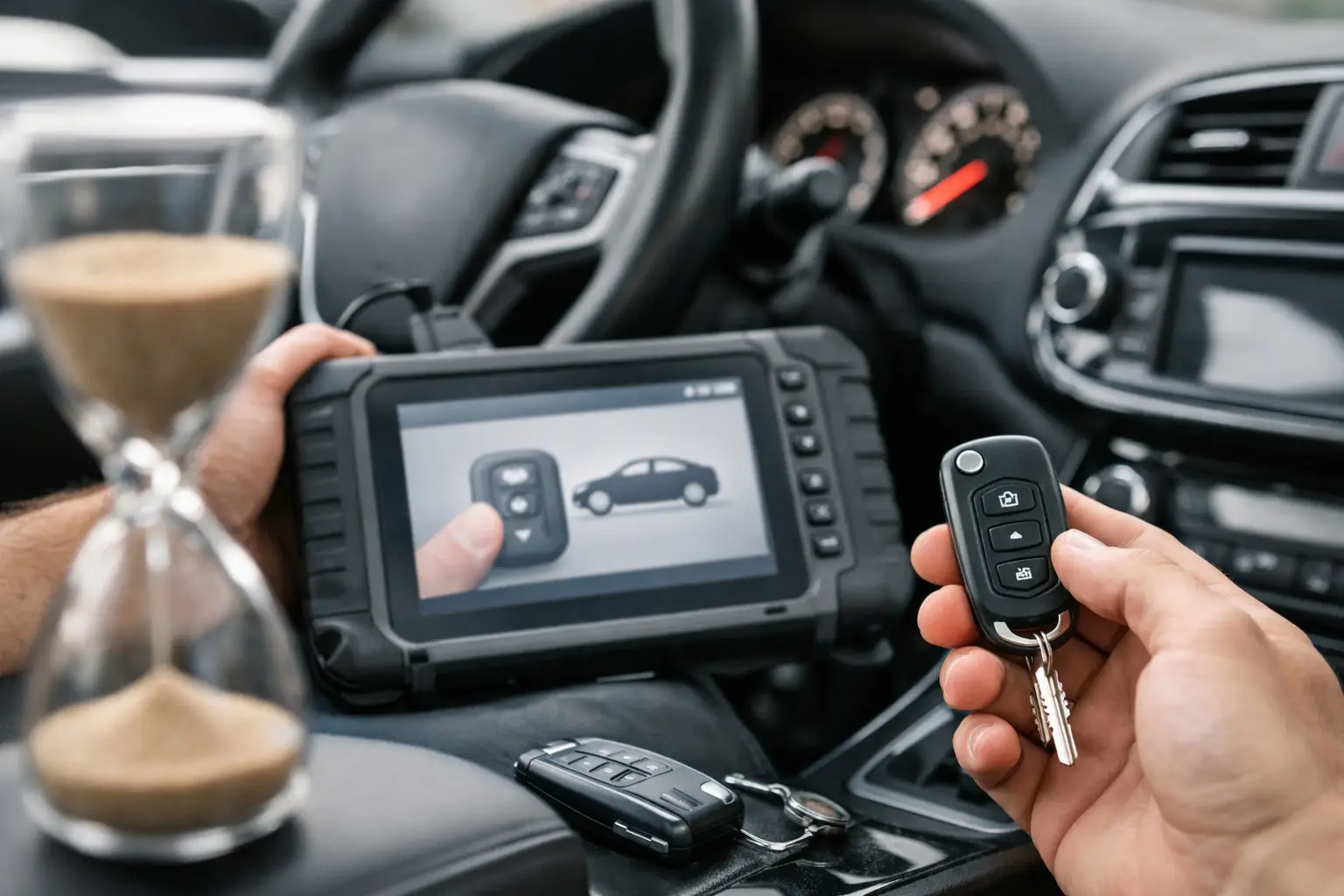
You usually ask how long does car key programming take when you are already losing time. Maybe you are locked out before work, standing in a parking lot with a dead key, or trying to get a spare made before the old one finally quits. The short answer is that most car key programming jobs take between 15 and 60 minutes. The real answer depends on the vehicle, the type of key, and whether anything else is wrong besides the programming.
How long does car key programming take in most cases?
For a straightforward job, programming a standard transponder key can often be done in around 15 to 30 minutes. If the vehicle uses a remote head key or a basic key fob setup, the time may still stay in that range if the system responds normally and there are no security delays.
For smart keys, push-to-start systems, and newer vehicles with more advanced immobilizer security, the job often takes 30 to 60 minutes. Some models are quick once the right equipment is connected. Others require multiple steps, security access, PIN retrieval, or sync procedures between the car and the new key.
If you are replacing all lost keys, the timing can stretch beyond an hour. That is because the technician is not just adding a spare. They may need to generate a key from the vehicle data, access immobilizer information, erase missing keys from memory, and test the new key fully before finishing the job.
Why the timing can vary so much
Car key programming is not one single process. It changes from one vehicle to the next, and even two cars from the same brand can have different systems depending on the year and trim.
The biggest factor is key type. A basic transponder key is usually faster than a proximity smart key. A spare key is usually faster than an all-keys-lost situation. If the blade also needs cutting, that adds time. If the remote buttons, immobilizer chip, and emergency insert all need matching, that adds more.
Vehicle security is another big factor. Some cars allow fairly direct programming with professional equipment. Others have built-in wait times, encrypted systems, or extra verification steps. That is why one car can be done in 20 minutes while another takes much longer even though both need a replacement key.
Condition matters too. If the battery in the car is weak, the ignition is damaged, the onboard system has faults, or a previous key was programmed incorrectly, the technician may need to solve those issues first. In that case, the delay is not really the programming itself. It is the fault-finding around it.
The difference between programming a spare key and replacing a lost key
If you still have one working key, the job is usually faster and more straightforward. The technician can verify the existing key, confirm the right chip or smart key type, and add the new key as a spare. In many cases, this is the quickest type of programming appointment.
If all keys are lost, the job becomes more involved. The technician may need to decode the lock, cut a new blade, communicate directly with the immobilizer system, and remove lost keys from the vehicle memory for security. That adds steps, equipment time, and sometimes extra diagnostics.
This is one reason a mobile automotive locksmith is often faster than going through a dealership route. A specialist who cuts and programs keys on site can handle the full job in one visit, rather than splitting the process across towing, ordering, and scheduling.
How long different key types usually take
A traditional transponder key is often the quickest option. If the key blank is in stock and the vehicle accepts programming without issue, it may be done in 15 to 30 minutes.
A remote head key, which combines the blade and remote buttons in one unit, often takes around 20 to 45 minutes. That includes cutting the blade, programming the chip, and syncing the remote functions.
A flip key is similar, though some vehicles take longer depending on the remote frequency and immobilizer setup. Expect roughly 30 to 45 minutes in many cases.
A proximity or smart key usually takes 30 to 60 minutes, and sometimes longer on higher-security models. Push-to-start systems can involve more communication between modules, so the process is less predictable.
Luxury brands and certain European vehicles can take more time than mainstream models. Not always, but often enough that it is worth knowing upfront. The programming path tends to be more complex, and some systems are less forgiving if there is a fault in the car.
What happens during car key programming
From the outside, it can look like the technician plugs in a machine and waits. In reality, there are several steps behind a proper programming job.
First, the technician confirms the exact vehicle details and checks that the replacement key is correct for that model. Then the mechanical blade may need to be cut if the key has one. After that, diagnostic equipment is connected to the vehicle to access the immobilizer or body control system.
Once access is established, the new key is introduced to the vehicle memory. On some vehicles, old keys can be deleted at the same time for security. The remote locking, trunk release, and panic functions may also need separate syncing depending on the setup.
The final part is testing. A proper job is not finished when the machine says programming is complete. The key needs to start the vehicle, turn the ignition if applicable, operate the remote functions, and behave consistently over repeated tests.
When programming takes longer than expected
The most common delay is getting the wrong key for the vehicle. Even small differences in chip type, board version, or frequency can stop the process or force a restart with a different key.
Security wait times are another issue. Some vehicles impose timed access periods before new keys can be added. That can mean sitting through a built-in delay before the actual programming even begins.
Faults in the car can also slow things down. A weak battery, damaged ignition, faulty antenna ring, water-damaged module, or previous failed programming attempt can all interfere. In those cases, a good technician will tell you clearly what is causing the delay instead of guessing on timing.
There is also a practical difference between a clean driveway job and a stressful roadside callout in poor weather or low light. Mobile service is convenient, but the working conditions still matter.
Can car key programming be done the same day?
In many cases, yes. Same-day programming is common when the right key is available and the vehicle does not have unusual security barriers. That is especially true for common makes and models where experienced technicians carry the right stock and tools.
The main exception is when a rare key has to be sourced, the vehicle has a major fault, or a specialized module issue needs extra repair before programming can succeed. For most everyday jobs, though, there is no reason you should be waiting days just to get a key paired to your car.
That is one of the biggest advantages of using a specialist service like Auto Tech Car Keys. The goal is not just to program a key. It is to get you moving again without dragging the job into a long process.
How to help the job go faster
If you want the appointment to move as quickly as possible, have the vehicle year, make, model, and VIN ready. If you still have a working key, keep it available. If the car battery has been weak, mention that early.
It also helps to explain the full problem, not just that the key does not work. For example, say whether the buttons failed first, the key turns but does not start the car, the key was stolen, or all keys are missing. Small details can change which equipment and key type are needed.
So, how long should you expect?
If you want a practical time frame, plan on 15 to 60 minutes for most programming jobs and a bit longer for all-keys-lost cases, smart keys, or vehicles with faults. That is a realistic expectation, not a sales promise. Some are faster. Some take longer.
What matters most is having the job done correctly the first time, with the key fully tested and the vehicle security system properly matched. A fast fix that leaves you with an unreliable key is not much of a fix at all.
If you need car key programming, the best approach is simple: get an accurate quote, give the vehicle details upfront, and use a technician who can cut, program, and test the key on site. When that happens, the wait is usually shorter than people expect, and a lot less painful than being stuck without a working key.