
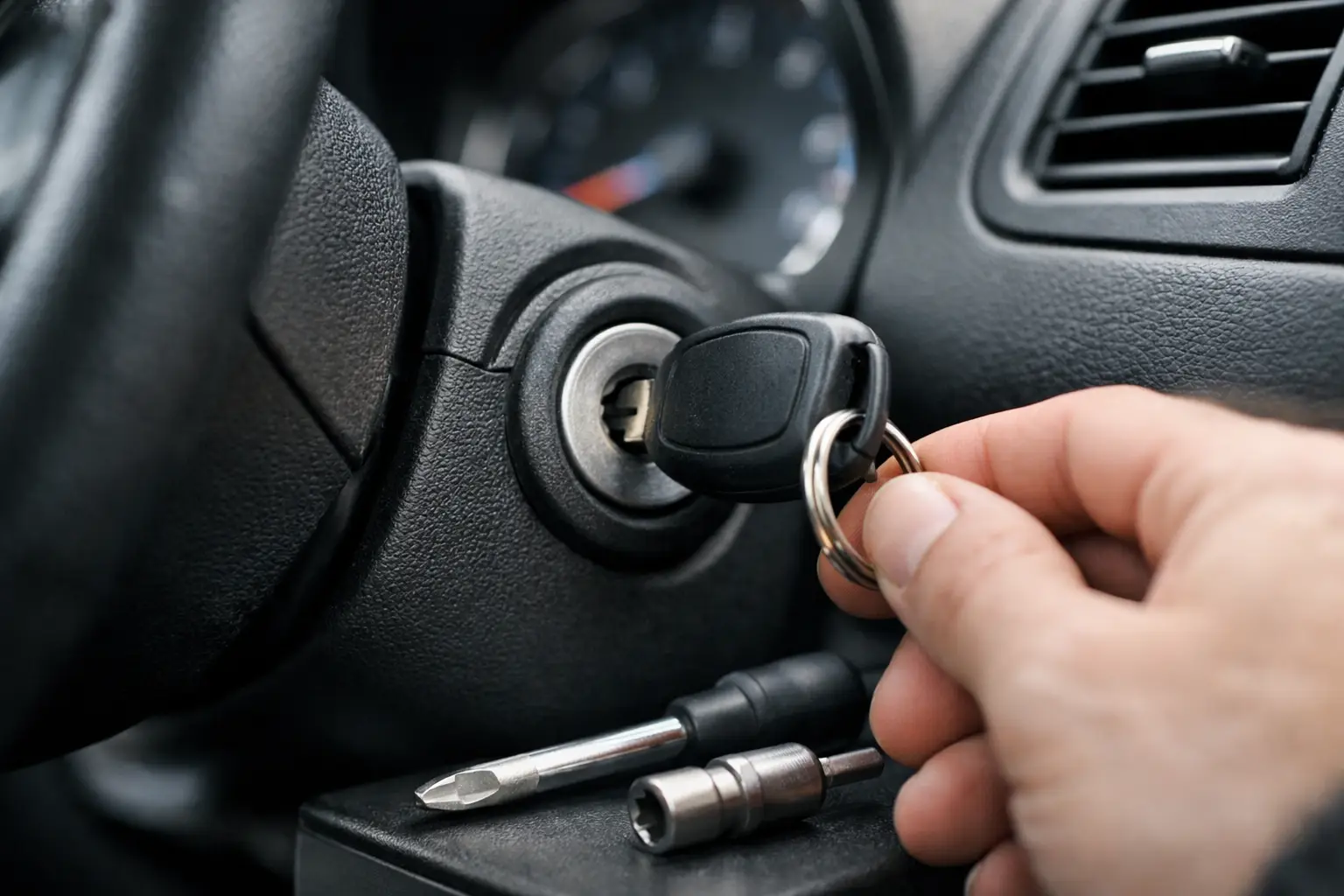
You try turning the key, the steering wheel stays locked, and nothing moves. If your Ford ignition barrel won’t turn, it usually feels like a major breakdown, but in many cases the cause is smaller than it seems. The key may be worn, the steering lock may be under pressure, or the barrel itself may be starting to fail.
The main thing is not to force it. A stuck Ford ignition can go from annoying to expensive very quickly if the key snaps or the barrel is damaged further. A careful check can save you time, money, and a recovery bill.
Why a Ford ignition barrel won’t turn
An ignition barrel turns only when several parts line up properly. The key has to match the internal wafers, the steering lock has to release, and on some models the gear selector or immobilizer system may also be part of the problem. When one of those parts is out of place, the key will not rotate.
On Ford vehicles, mainly ford transit vans belong to tradesmen, the most common causes are key wear, barrel wear, steering lock tension, dirt inside the ignition, or an internal fault in the ignition housing. Sometimes the problem starts gradually. The key may feel stiff for a few days or only stick when parked on an incline. Other times it happens without warning.
If the key still inserts fully but will not turn, that usually points to either a worn key, a worn barrel, or steering lock pressure. If the key does not insert properly at all, there may be debris in the barrel or internal damage.
First things to try before calling for help
Start with the simple checks. They solve more ignition problems than most drivers expect.
Relieve pressure on the steering wheel
If the front wheels are turned when you parked, the steering lock can bind tightly against the ignition. Hold the key gently in the ignition and turn the steering wheel left and right with firm but controlled pressure. As you do that, try to rotate the key.
Do not yank the wheel or twist the key hard. You are trying to release pressure, not overpower the lock. If this is the issue, the key usually frees up within a few seconds.
Check the key itself
A worn Ford key can still open the doors but struggle in the ignition. Look for rounded edges, visible wear, bends, or cracks. If you have a spare key, try that next. A spare that turns normally is a strong sign the original key is the problem, not the barrel.
This matters because many drivers keep using a worn key until it finally stops working. At that point, forcing it can damage the ignition wafers and turn a key issue into a barrel replacement.
Make sure the gear selector is fully in park
On automatic Ford models, the ignition may not release properly if the vehicle is not fully in park. Press the brake, move the selector firmly into park, and try again. On manual models, make sure the car is settled and not placing unusual tension through the steering system.
Look for dirt or obstruction
Dust, lint, and small debris can build up inside the ignition barrel over time. If the key feels like it does not slide in smoothly, there may be contamination inside. Avoid poking metal objects into the barrel. That often makes things worse.
A locksmith can clean and assess the barrel safely on site. DIY sprays and lubricants are more of a gamble. Some help temporarily, but the wrong product can attract more dirt or interfere with the lock mechanism.
Signs the Ford ignition barrel is worn out
Ignition barrels rarely fail without warning. Most show a pattern first. The key may need jiggling to start the car. It may work better in one direction than another. You may notice the key sticks when removing it, or the ignition feels rough and inconsistent.
If your Ford ignition barrel won’t turn one day but has felt stiff for weeks, wear is the likely cause. Inside the barrel are small moving parts that match the cut pattern of your key. Over time, both the key and those internal parts wear down. Once the match is poor enough, the barrel stops recognizing the key position correctly.
This is especially common when a driver keeps one heavily used key for years and never rotates to a spare. It is also more likely if the key has been dropped often, bent in a pocket, or used while carrying a heavy keyring that pulls on the ignition over time.
When it is the key and not the barrel
A faulty key can mimic a failed ignition. If the blade is worn, cut badly, or slightly twisted, the ignition wafers may not line up even though the key still fits. Remote keys and transponder keys add another layer because the electronic chip must also be recognized by the vehicle, though that usually affects starting rather than the key physically turning.
If the key turns sometimes and not others, pay attention to whether it works better when inserted gently, pulled back a fraction, or used with a certain angle. Those are classic signs of wear. A new properly cut key may solve the issue without any barrel repair.
That is one reason an automotive locksmith is often the faster option than replacing parts blindly. The right technician can test whether the fault sits with the key, the barrel, or both.
What not to do if the ignition is stuck
This is where many small problems become expensive ones. Do not force the key with pliers. Do not hammer the key. Do not flood the barrel with random lubricant. And do not keep twisting harder if you feel resistance.
A snapped key inside the ignition creates a second job straight away. A damaged barrel can also affect the steering lock housing and, on some vehicles, lead to more extensive repair work. If the ignition feels solidly jammed after the basic checks, stop there.
There is also a safety reason to be careful. If you are stuck in a busy road, car park entrance, or awkward location, trying repeated fixes under stress can lead to more damage and more delay. At that point, getting proper help is usually the cheaper decision.
Can you repair a Ford ignition barrel, or does it need replacing?
It depends on the fault. Some ignition problems come from dirt, minor sticking, or a worn key, and those can sometimes be resolved without replacing the full barrel. If the internal wafers are damaged, the barrel is heavily worn, or the housing has developed a fault, replacement is often the reliable fix.
A good diagnosis matters here. Replacing the barrel when the key is the real issue wastes money. Recutting a key when the barrel is failing only delays the problem. The right repair is the one based on testing, not guesswork.
For many drivers, convenience matters as much as price. A mobile automotive locksmith can usually inspect the issue where the vehicle is parked, which is useful if the steering is locked and the car cannot be moved easily. In South London, that can save a lot of disruption compared with arranging dealership recovery and waiting for workshop availability.
When to call an automotive locksmith
Call for help if the spare key does not work, the key will not insert properly, the ignition feels jammed solid, or the key is at risk of snapping. You should also call if the problem keeps returning. An ignition that works only after repeated jiggling is already telling you something is worn.
A specialist automotive locksmith can usually check the key cut, inspect the barrel, extract broken keys if needed, and repair or replace faulty ignition components. In many cases, they can also cut and program replacement keys on site. That reduces downtime and avoids the back-and-forth many drivers face with a dealership.
For a service business like Auto Tech Car Keys, this type of fault is exactly the kind of job where speed matters. When your car will not start because the ignition is locked, you do not need vague advice. You need someone who can get to the vehicle, identify the fault properly, and fix it without adding unnecessary cost.
How to reduce the chances of it happening again
Use your spare key occasionally so one key does not take all the wear. Replace a damaged or heavily worn key before it starts affecting the ignition. Keep your keyring light, because excess weight can strain the ignition over time. And if the ignition starts feeling stiff, deal with it early rather than waiting for a full lock-up.
Most drivers get caught out because the warning signs seem minor. A sticky turn here, a little jiggle there, and then one day the car will not start at all. Catching it early gives you more options and usually a lower bill.
If your Ford ignition barrel won’t turn, start with the safe checks, avoid forcing anything, and treat recurring stiffness as a repair issue rather than a quirk. That approach gives you the best chance of a straightforward fix and keeps a bad morning from turning into a bigger job.