
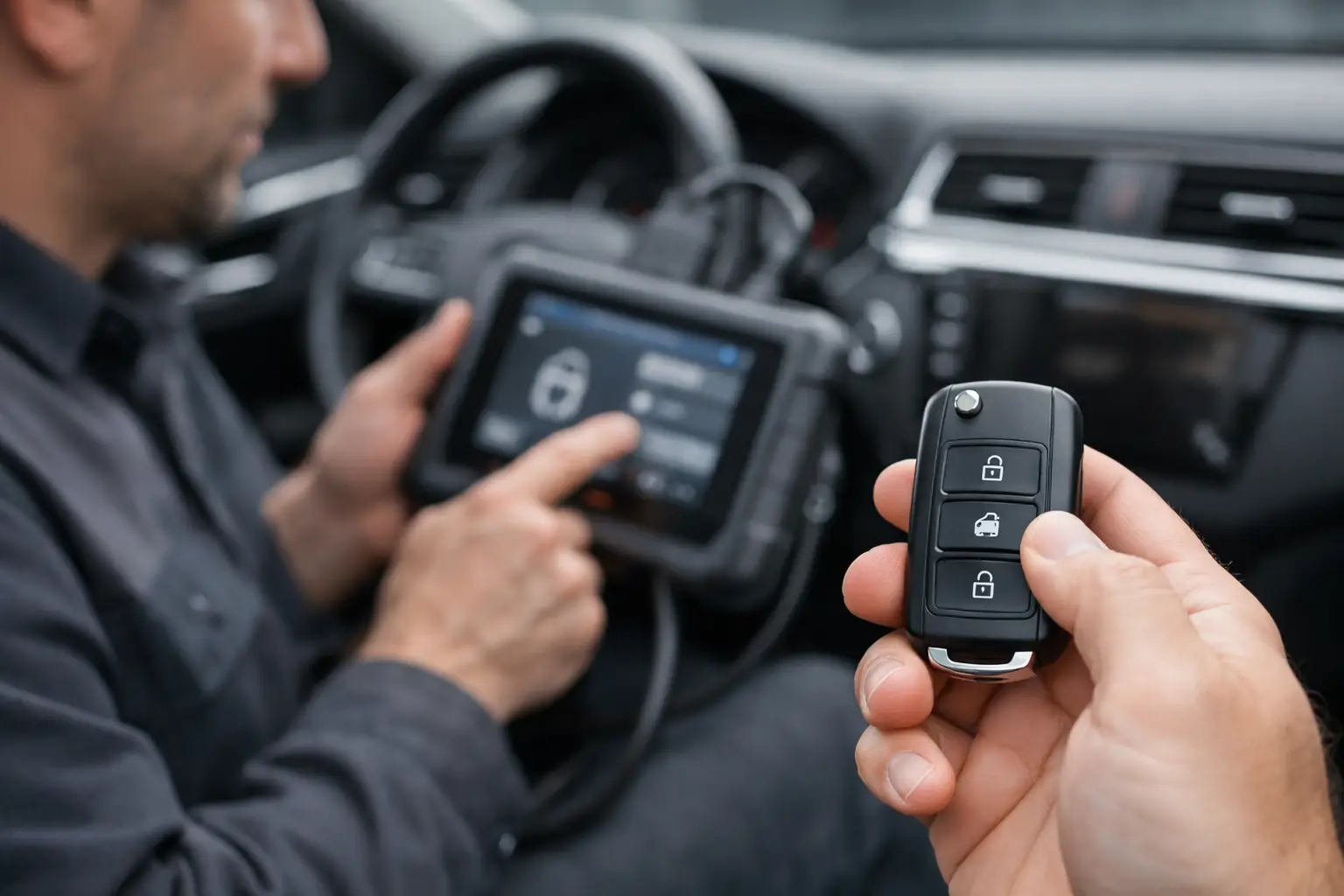
You usually find out how much your key matters when the car stops recognizing it. One minute you are heading to work, school pickup, or a job site. The next, the remote does nothing, the ignition will not respond, or the dashboard flashes a security warning. This car key programming guide explains what programming actually means, when it can be done quickly, and when it needs a specialist with the right tools.
What car key programming actually means
Programming a car key is the process of matching a key or fob to your vehicle’s security system so the car knows it is authorized. That can include remote lock functions, immobilizer chip recognition, push-to-start operation, or all three.
A lot of drivers assume key cutting and key programming are the same job. They are not. Cutting gives you the right physical shape for the blade. Programming handles the electronic side. A key can be cut perfectly and still fail to start the car if the chip or fob is not paired correctly.
That matters more on newer vehicles. Older models sometimes allowed simple onboard procedures, where you could cycle the ignition or press a sequence of buttons to add a remote. Many modern cars require diagnostic equipment, security access, and software that communicates directly with the vehicle.
Why some keys are easy and others are not
Not all keys work the same way, and that is where most confusion starts. A basic metal key with no chip is simple. If it only turns the lock and there is no immobilizer system, no programming may be needed at all.
A transponder key is different. It contains a chip that sends a coded signal to the car. If that signal does not match what the vehicle expects, the engine may crank and die, or not start at all. A remote head key combines the cut blade with lock and trunk buttons. A smart key or proximity fob adds push-button start and keyless entry.
Each setup changes the process. Some vehicles allow one working key to help program a second. Others need all keys erased and re-added during the job. Some European models have stronger security protocols that make DIY attempts unrealistic. So if you are looking for a one-size-fits-all answer, there really is not one.
A practical car key programming guide by key type
If you are dealing with a plain mechanical key, the job is usually about cutting, not programming. That is the least complicated scenario.
If you have a transponder key, programming is often required even if the key blade fits the locks. The car’s immobilizer has to accept the chip ID. Without that step, the key is useless for starting the vehicle.
If you have a remote fob, there may be two separate tasks. One is programming the remote buttons for lock and unlock. The other is pairing the transponder or smart function that allows the engine to start. Sometimes the buttons work but the car still will not start. That points to partial programming or the wrong chip.
If you have a smart key, the process is usually more involved. These systems often require specialist diagnostics, secure access procedures, and exact compatibility with the vehicle make, model, and year. A cheap replacement fob bought online may look identical and still fail because the internal board, frequency, or chip type is wrong.
When DIY programming works
DIY programming can work on certain older vehicles, especially when the goal is adding remote lock functions rather than replacing a fully lost key. If the owner’s manual includes a clear onboard procedure, and you still have at least one working key, you may have a reasonable shot.
That said, even in DIY-friendly cases, details matter. The replacement key has to be the correct type. The chip has to be compatible. The battery in the fob needs to be good. And the sequence has to be followed exactly, with the right timing.
Where drivers get into trouble is assuming every online video applies to their vehicle. The same model line can use different systems across different years or trim levels. A method that works on one version may do nothing on another.
When you should call a specialist
If all keys are lost, if the car uses push-button start, if the ignition shows a security or immobilizer warning, or if the replacement key is not being accepted after basic attempts, it is time to bring in a specialist. The same applies if the key is damaged, snapped, water-exposed, or intermittently recognized.
A professional automotive locksmith does more than press a few buttons. They confirm the correct key type, cut the blade if needed, access the vehicle’s key data, program or clone where appropriate, and test every function before finishing the job. In many cases, that can be done on-site, which saves the time and cost of towing the car to a dealership.
For drivers who need the car back on the road quickly, that convenience is a big deal. It is also often the difference between a same-day fix and a drawn-out replacement process.
Common mistakes that make the job harder
The biggest mistake is buying the wrong key or fob. Matching the shell is not enough. The chip, frequency, and board version all have to line up with the vehicle.
The second mistake is assuming a dead battery is the only issue. Sometimes the fob battery is fine, but the key has lost synchronization, the transponder chip is damaged, or the vehicle has a receiver fault.
The third is repeated DIY attempts after the first signs of failure. On some systems, too many incorrect tries can complicate the process or waste time when the real problem is compatibility. It is better to verify what type of system your vehicle uses before forcing a fix.
Another common issue is skipping diagnosis when the symptom points somewhere else. If the key turns but the ignition sticks, or the fob works but the car will not crank, the fault may involve the ignition barrel, antenna ring, vehicle battery, or another component. Programming alone will not solve that.
How long programming usually takes
If the correct key is in hand and the vehicle cooperates, programming can be quick. Straightforward jobs may take well under an hour. More complex systems, all-keys-lost cases, or vehicles with security access delays can take longer.
That is why pricing and timing can vary. A spare key added to a working system is usually simpler than replacing the only lost smart key for a late-model vehicle. The labor is different, the equipment is different, and the risk of compatibility issues is higher.
Good service should be clear about that upfront. A reliable technician will usually ask for the vehicle make, model, year, and the exact problem before quoting anything. That is not stalling. It is how you avoid the wrong key and the wrong price.
What to have ready before the job
You can help speed things up by having your vehicle details ready, along with photo ID and proof of ownership if required. If you still have a working key, keep it available. If the problem started after battery replacement, water damage, or dropping the key, mention that too.
Small details often point to the right fix faster. A key that stopped working suddenly is a different case from one that has been unreliable for weeks. A car that unlocks but will not start is a different case from a complete no-response fob.
The smart move if you only have one key
If you still have one working key, that is the best time to get a spare programmed. Waiting until the last key is lost usually means a more expensive and more time-sensitive job. It also increases the chance of getting stranded at the worst possible moment.
For most drivers, a spare is not a luxury. It is damage control. It gives you options when a key breaks, goes missing, or gets locked in the car. If you rely on your vehicle every day, having a backup key is often the cheapest way to avoid a major disruption later.
A solid car key programming guide should leave you with one practical takeaway: modern keys are part metal, part electronics, and part security system. When the setup is simple, you may be able to handle it yourself. When it is not, the fastest and least expensive path is usually getting the right help early, before a small key problem turns into a full day off the road.