You realize the keys are sitting on the seat the second the door clicks shut. Or worse, the fob stops responding in the rain when you are already late. If you are searching for how to get car door unlocked, the fastest answer is not always forcing the door open. The safest approach depends on your vehicle, your key type, and why the car is locked in the first place.
Modern vehicles are harder to open without the correct tools and training, and that is usually a good thing for security. It also means bad advice can turn a simple lockout into a damaged weather seal, scratched paint, a broken handle, or an airbag-related repair. A calm, methodical approach saves time and often saves money too.
How to get car door unlocked without making it worse
Start with the obvious checks before trying anything physical. Make sure every door is actually locked, including the trunk or hatch. On some vehicles, one door may stay openable even when the driver door is not. If you have a push-button start vehicle, check whether the fob battery is dead rather than assuming the car is fully locked out. Sometimes holding the fob close to the start button or door handle works as a temporary measure.
If a child or pet is inside the vehicle, or the engine is running in unsafe conditions, stop troubleshooting and get emergency help right away. In that situation, speed matters more than saving a service call.
If there is no immediate danger, think about the cause of the lockout. Did you lock the keys inside? Lose the key completely? Snap the key in the lock? Is the key fob not responding? Those are different problems, and each one changes the best next step.
If the keys are locked inside the car
This is the situation most drivers picture first. Years ago, people could sometimes use a slim tool or a wedge-and-reach method with little risk. On many newer cars, that is no longer a safe DIY move. Side airbags, sensitive wiring, frameless windows, and tighter sealing all make forced entry more likely to cause damage.
If your car has an app-based remote access feature, try that first. Some manufacturers allow remote door control through a mobile app, provided the car is connected and your account is active. If you have a spare key at home and someone can bring it quickly, that is often the cleanest fix.
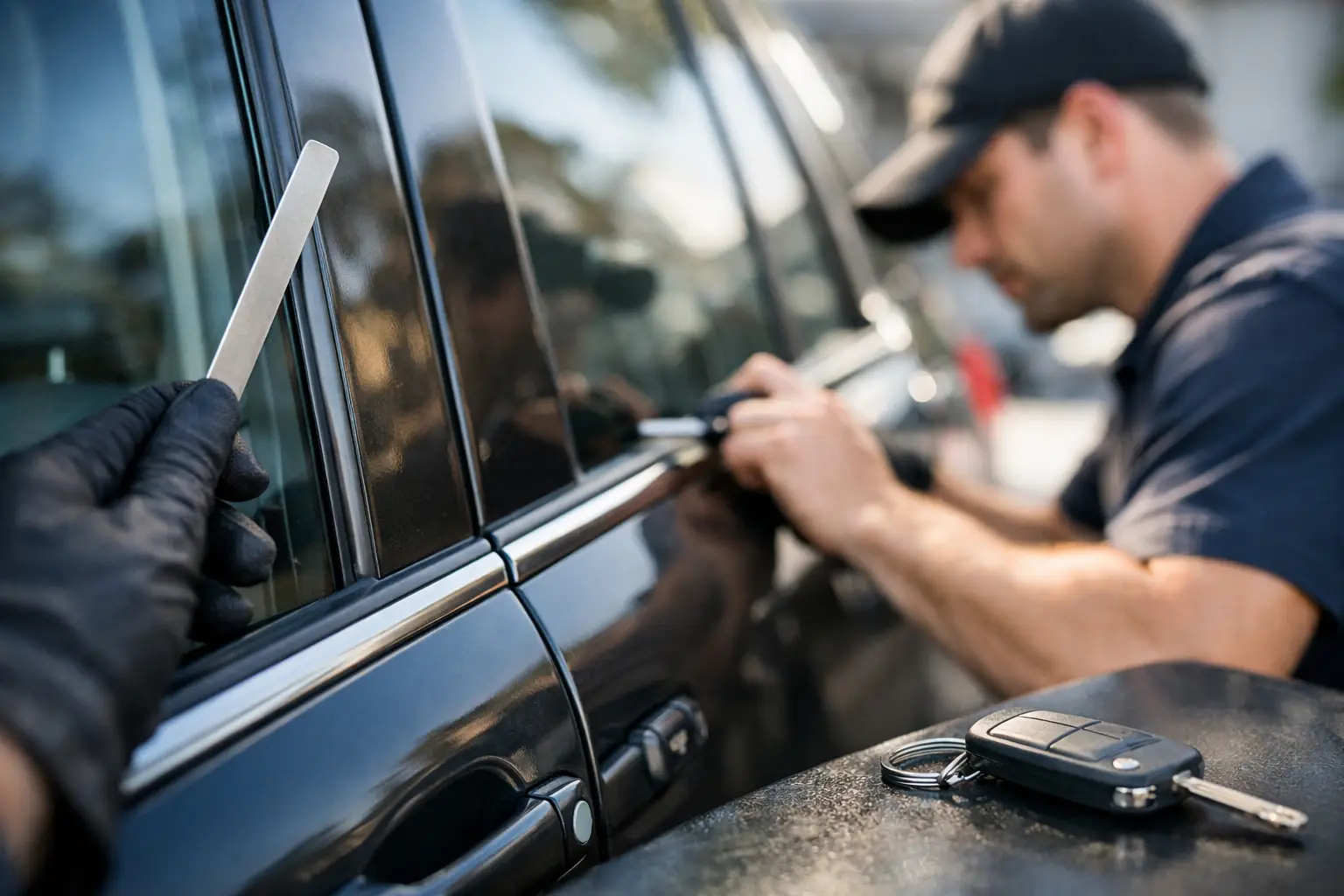
If neither option is available, a mobile automotive locksmith is usually the fastest practical choice. A trained technician can identify the entry method that fits your vehicle and open it with far less risk than improvised tools.
If the key fob stopped working
A dead fob battery is common and often mistaken for a full lockout. Try the spare fob if you have one. If the spare works, the issue is likely battery-related or a fault in the original fob. If neither works, the problem could be vehicle battery failure, a programming issue, or damage to the fob itself.
Some cars include a hidden mechanical key inside the fob. That key can open the door manually, though the key slot may be covered by a trim cap on the handle. Check your owner materials if you are unsure where it is. Pulling at trim without knowing the design can break plastic parts that are expensive to replace.
If the key is lost or broken
If the key is gone entirely, getting the car door open is only part of the job. You may also need a replacement key cut and programmed on-site. This is where a specialist automotive locksmith is different from a general lock service. Vehicle keys often need chip programming, remote pairing, or proximity setup after entry is gained.
If the key broke in the door or ignition, do not keep trying to turn the remaining piece. That can push fragments deeper into the lock or damage the ignition barrel. Extraction is usually straightforward with the right tools, but much less so after repeated DIY attempts.
What not to do when your car is locked
A lot of online advice skips the cost of getting it wrong. Coat hangers, screwdrivers, kitchen knives, and homemade wedges can bend the door frame, tear the weather stripping, scratch the glass, or damage the lock linkage. On newer vehicles, they can also interfere with electronics inside the door.
Another mistake is assuming every car opens the same way. A method that worked on an older sedan may be completely wrong for a late-model SUV with double-locking, deadlocks, or shielded linkages. If you are not certain how your vehicle is designed, guessing is where repair bills start.
It is also worth avoiding repeated remote button presses if the car battery may be low. That can confuse the diagnosis and waste time when the real issue is power, not access.
When calling a locksmith is the right move
The right time to call is sooner than most people think. If you have already checked for a spare, tested the fob, and confirmed there is no simple entry option, professional help is usually the most efficient route.
A qualified automotive locksmith should be able to tell you, before arrival, what information they need. Expect to provide the make, model, year, your location, and a description of what happened. That helps them bring the right tools and prepare for whether the job is entry only or entry plus key replacement.
For drivers dealing with urgent lockouts in South London, a mobile specialist such as Auto Tech Car Keys can typically handle both access and key-related problems on-site, which avoids the delays many people run into when a dealership is the only plan.
How long it usually takes
Simple vehicle entry can be quick, but there is no honest one-size-fits-all answer. The time depends on the vehicle, whether the lockout is caused by a dead battery, and whether programming is needed after entry. A straightforward access job may take less time than a lost-key situation that requires cutting and programming a new key.
That is why the cheapest advertised price is not always the best value. If the technician cannot actually complete the key work after opening the door, you may end up paying twice.
How to choose the right help
Not every locksmith handles vehicles at the same level. Ask whether they specialize in automotive work, whether they can make and program keys, and whether they work on your specific make. That matters especially with European brands, smart keys, and newer anti-theft systems.
Pricing should be clear before work starts. A professional service can usually explain the callout, the likely labor involved, and whether programming or parts may add to the total. If someone is vague about cost or avoids giving even a reasonable range, that is a warning sign.
Response time matters too, but so does method. Fast is useful only if the entry is clean and the vehicle is left in working order.
Preventing the next lockout
Once you are back in the car, it is worth fixing the reason it happened. If your fob battery is weak, replace it now rather than after the next missed signal. If you only have one working key, getting a spare made is usually far cheaper than dealing with a full lost-key emergency later.
Drivers who rely on their car every day often put this off until they are stranded in a parking lot or outside their home late at night. A spare key is not exciting, but it is one of the simplest ways to avoid disruption.
It also helps to check whether your vehicle offers app-based access, roadside support through your insurer, or a hidden mechanical key feature. Knowing what your car can do before there is a problem makes a stressful moment much easier to manage.
The best answer depends on the car
When people ask how to get car door unlocked, they usually want a universal trick. In real life, there is no single method that is safe for every vehicle. Older cars, newer cars, manual locks, smart keys, dead batteries, and broken keys all change the right approach.
The smart move is simple: rule out the easy fixes, avoid forcing the door, and get specialist help when the situation calls for it. A quick decision at the start can save you from a much bigger repair by the end of the day.
If it happens again, remember this: getting back into the car matters, but getting back in without creating a second problem matters more.