You realize how much your car key does the moment it stops working. If you are stuck with a lost key, a dead fob, or a replacement that still will not start the car, the first question is usually the same: can a locksmith program car keys? In many cases, yes. A qualified automotive locksmith can often cut, program, and test a replacement key on-site without sending you to a dealership.
That said, it depends on the vehicle, the key type, and what has gone wrong. Some jobs are straightforward. Others involve security systems, damaged modules, or manufacturer restrictions that make the process more complicated.
Can a locksmith program car keys for every vehicle?
Not every vehicle, but many of them. Modern automotive locksmiths work with transponder keys, remote head keys, smart keys, and proximity fobs for a wide range of makes and models. If the vehicle accepts onboard or diagnostic programming and the correct equipment is available, a locksmith can usually handle the job.
The biggest factor is the security system built into the car. Older metal keys with no chip are simple. Transponder keys, which contain a chip matched to the immobilizer, require programming so the engine will recognize the key. Push-to-start systems add another layer, since the vehicle must detect and authorize the smart key before it will start.
Some newer vehicles have tighter security gateways or encrypted systems that limit third-party programming. In those cases, a dealer may be required, or the locksmith may need specific proof of ownership and advanced tools to complete the work. A good locksmith will tell you that upfront rather than waste your time.
What types of car keys can a locksmith usually program?
A trained automotive locksmith can usually program several common key types. Standard transponder keys are one of the most common jobs. These look like regular keys, but they contain a chip that must be paired to the car.
Remote head keys are also common. These combine the metal blade and remote buttons in one unit, so the locksmith may need to both cut the key and program the remote functions.
Smart keys and proximity fobs can often be programmed as well, especially for common models. These systems are more complex, but mobile locksmiths who specialize in vehicle keys often carry the diagnostic tools needed to add, erase, or replace fobs on-site.
What a locksmith cannot promise over the phone is that every aftermarket key will work the same way as an original factory key. Sometimes the replacement performs perfectly. Sometimes certain comfort features or remote range differ slightly. That is why key quality matters, not just the programming step.
How the programming process works
Programming a car key is not just plugging in a machine and pressing a button. The locksmith first identifies the vehicle, verifies ownership, and confirms the exact key type the car requires. Using the wrong blank or wrong chip can waste time and money.
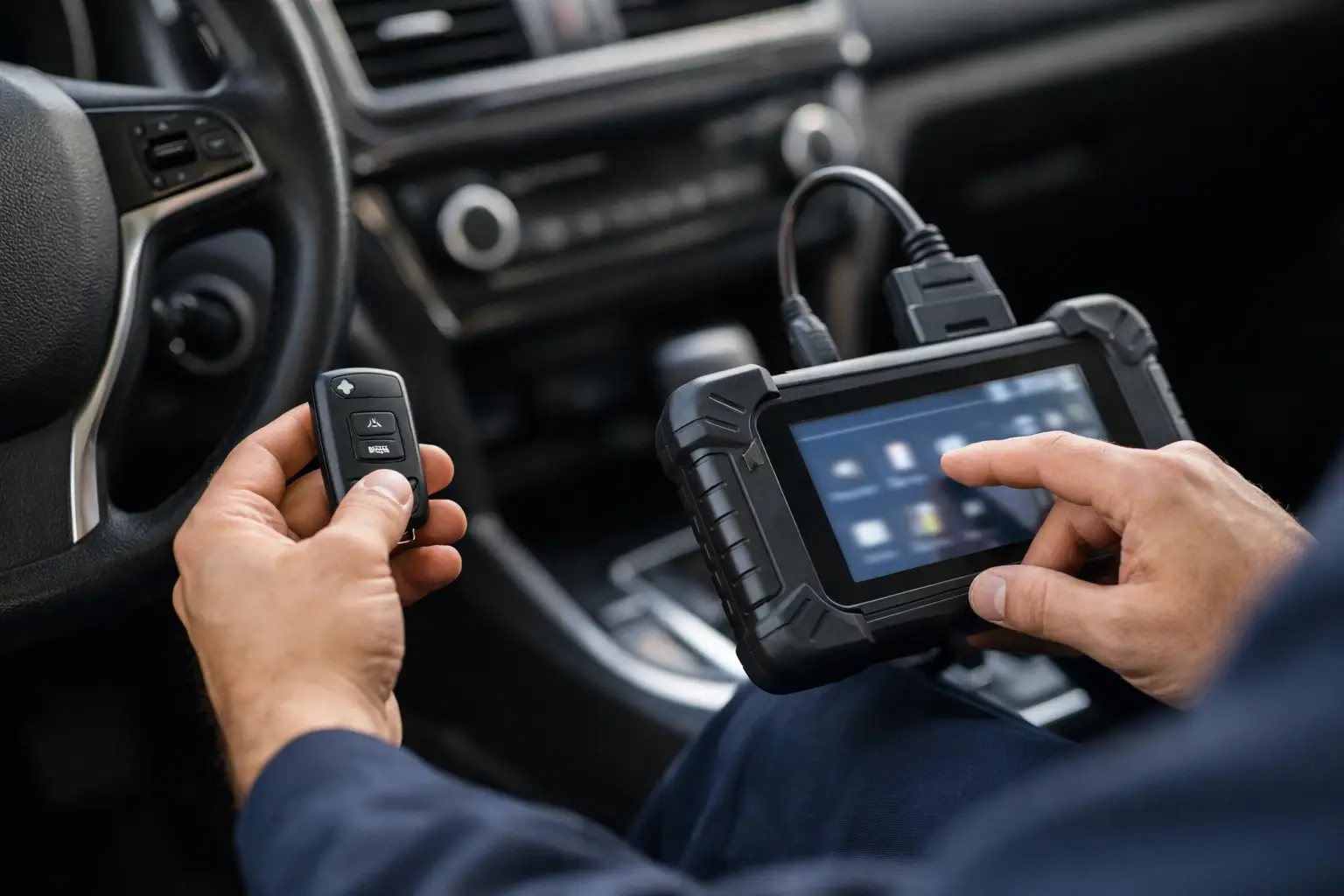
If the key needs cutting, that happens before or alongside programming. For transponder and smart keys, the locksmith typically connects diagnostic equipment to the vehicle, accesses the immobilizer or body control system, and registers the new key to the car. In some vehicles, old lost keys can also be deleted from memory so they no longer start the engine.
After that, the key should be fully tested. That means checking lock, unlock, trunk release, panic button, remote start if equipped, and most importantly, engine start authorization. A proper job is not finished when the key looks right. It is finished when the car responds the way it should.
When a locksmith is often better than a dealership
For many drivers, the main advantage is speed. If you are stranded at home, at work, or in a parking lot, a mobile automotive locksmith can usually come to you. That avoids towing fees, scheduling delays, and the hassle of getting the car to a dealer just to replace a key.
Cost is another reason people call a locksmith first. Dealership pricing often includes the key, programming, and sometimes additional labor or diagnostic fees. An automotive locksmith can often provide a more affordable option, especially for spare keys or common lost-key situations.
There is also a practical difference in service. A specialist who deals with broken blades, worn ignitions, damaged shells, stuck keys, and emergency lockouts every day tends to look at the whole problem. Sometimes the issue is not only programming. It might be a failing ignition, a snapped key, a weak battery in the fob, or a damaged key casing causing intermittent problems.
When a dealer may still be necessary
There are times when a locksmith is not the final answer. Some high-security systems require dealer-level access or online manufacturer authorization. Certain luxury brands and very new models are more likely to fall into this category.
If the vehicle has module faults, immobilizer corruption, or previous unsuccessful programming attempts, the issue may go beyond the key itself. A locksmith can often diagnose this, but if a control unit needs factory coding or replacement, the next step may involve the dealer or a specialist with brand-specific software.
It also matters whether all keys are lost. Some vehicles are simpler to add a spare key when one working key is still available. Starting from zero can be more involved because the system must be accessed and new credentials written from scratch.
A trustworthy locksmith will not oversell what they can do. If the right move is dealer involvement, you should hear that early.
Can a locksmith program car keys if all keys are lost?
Often, yes. This is one of the most common callouts for an automotive locksmith. The process usually includes decoding or cutting a new mechanical key, then programming a transponder chip or smart fob so the car recognizes it.
All-keys-lost jobs are usually more expensive than making a spare because there is no working key to copy or reference. The locksmith may need to read locks, access vehicle data, or reset the immobilizer memory. It is still often faster and more convenient than arranging dealer recovery.
If you drive regularly for work, school runs, or appointments, this is also why having a spare key matters. Replacing one lost key is usually simpler than rebuilding access from nothing.
Signs you need programming, not just a new battery
A lot of drivers assume the key is dead when the buttons stop responding. Sometimes that is true. A weak fob battery can cause poor signal, inconsistent unlocking, or total remote failure.
But if the car says no key detected, key not recognized, or turns over without starting, that points more toward a transponder or smart key communication issue. If you have had a new shell fitted, the internal chip may not have been transferred properly. If the key was dropped in water, run over, or physically cracked, the electronics may be damaged even if the blade still turns.
This is where experience matters. A locksmith who specializes in car keys can usually tell whether the problem is the battery, the key, the programming, or the vehicle side of the system.
What to ask before booking the job
Before you call someone out, it helps to ask a few direct questions. Can they program keys for your exact make and model? Do they come to your location? Is the quote for cutting and programming, or programming only? Will the replacement key match remote functions as well as engine start? And if the first key fails due to a hidden vehicle issue, what diagnostic steps are included?
You should also expect to show proof that the vehicle is yours. That protects everyone involved and is standard practice for a professional automotive locksmith.
For drivers who want a fast answer without dealership delays, a specialist mobile service like Auto Tech Car Keys can often sort the problem at your location, especially for common transponder and smart key issues.
The real answer
So, can a locksmith program car keys? Very often, yes – and for many drivers, it is the quickest and most cost-effective route. The key is choosing an automotive locksmith who handles vehicle security systems every day, not a general locksmith guessing with limited tools.
If your key is lost, damaged, or simply not talking to the car anymore, the smartest next step is not to assume the worst. Get the vehicle and key type checked properly, because the right fix is often simpler than it first looks.